
From Blue Suits to Blue Overalls to Blueprints
For Conrad Kotze, a career in construction was not part of the original plan.
Before moving to New Zealand, Conrad worked in South Africa as a qualified GIA Jewellery and Polished Diamond Grader, spending his days in a blue suit grading gemstones and diamonds. But when he immigrated to New Zealand, that career path was no longer available. Like many migrants, he had to start again from scratch.
Through a connection at his wife’s school, Conrad was introduced to Jacob and Marijke Aperloo at Aperloo Partnership. Jacob gave him the opportunity to begin a carpentry apprenticeship, teaching him the trade from the ground up.
“I traded the blue suit for blue overalls,” Conrad says. “At the beginning I didn’t even know the names of the tools in the van. Jacob would ask for something, and I’d have no idea what I was looking for.”
Over time, Conrad built his skills on the tools and developed a strong understanding of how buildings come together in practice. He completed his carpentry qualification just two months after a serious injury forced him off the tools for good.
Rather than let that setback define him, Conrad used it as a springboard. He reached out to engineers, architects, and technicians for honest advice about his next move and came away with a clear direction: Architectural Technology.
“I didn’t even know the difference between a Registered Architect and an Architectural Technician. I had to ask the ‘dumb’ questions to find where I fit.”
Today, Conrad describes his career as moving through three distinct phases: blue suits, blue overalls, and now blueprints.
His years on the tools taught him how buildings go together. Now he wants to understand why: the design logic, the compliance requirements, and the documentation discipline that underpins every successful project.
He enrolled in the New Zealand Diploma in Architectural Technology (Level 6) at the Open Polytechnic and has not looked back since.
Removing the cost of entry
Conrad says the transition into study required a conscious decision to make the most of an unexpected situation. While recovering from his injury and receiving ACC support, he chose to begin reskilling rather than wait for the next opportunity. The baseline income helped create stability during recovery, while the CGF scholarship reduced the financial pressure of study and allowed him to focus on building the skills needed for his next career step.
The scholarship covered the hardware he needed to keep pace with his studies and gave him the financial breathing room to volunteer one to two days a week in a Masterton design office alongside experienced mentor Mark Jerling. Without that support, the unpaid time simply would not have been possible.
"The scholarship took the handbrake off. This path is expensive. The hardware alone is a massive hurdle. It made sure I wasn't held back by the cost of entry while I was already navigating a career pivot."
Learning in the engine room
Volunteering in Mark Jerling’s Masterton office is where much of the real learning has taken place. When Conrad first opened Revit, the BIM modelling software used across the industry, he admits he did not even know how to draw a line. With early guidance from Willem van der Laan and day-to-day mentoring from Mark, that steep learning curve quickly turned into an accelerated apprenticeship in digital design.
Today he is tackling one of the most technically demanding projects the office has seen.
Featured Project: Re-clad of an original Roger Walker house
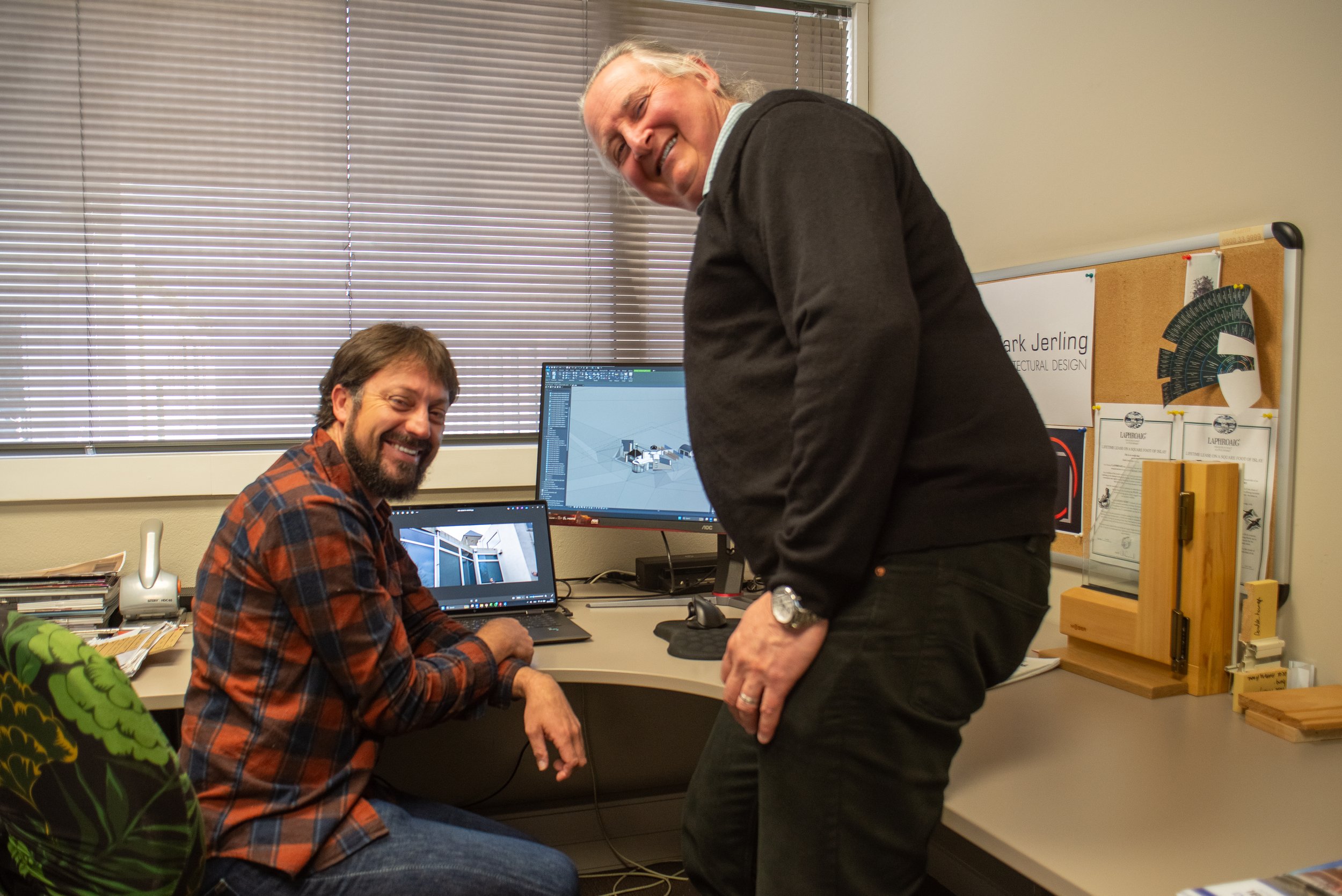
Left: Conrad Kotze with Mark Jerling
The project involves the re-clad of an iconic Roger Walker-designed residence. Known for their distinctive and complex geometry, Walker’s buildings present unique challenges when translating older documentation into modern BIM environments.
Conrad received the IFC files from the previous architect and has been responsible for translating and migrating the entire model into Revit 2025. Managing that data transfer while maintaining accuracy has become a significant BIM management exercise.
“I’m not the mastermind behind the architecture,” Conrad says, “but I am the one solving the software puzzles so we can actually execute the re-clad on such an iconic building.”
Beyond the technical work, Conrad has also built a wide circle of mentors and supporters across the industry. Through the New Zealand Institute of Building, professionals such as Jake Nash and Ben Bourke have provided guidance along the way, while Pamela Bell introduced him to emerging AI tools at DigiConn23.
He has also invested in his own professional development, self-funding Dale Carnegie training because, as he puts it, technical skills only go so far if you cannot communicate effectively.
Documentation is the engine room
From his years on the tools, Conrad understands something that not every designer does: poor drawings cost contractors time, money, and goodwill. Qualified Architectural Technologists do not just produce drawings; they manage risk, improve buildability, and protect everyone involved in a project. Having someone in that role who has actually swung a hammer makes the documentation sharper and more grounded in reality.
Conrad is also building that capability in the Wairarapa, a region that deserves strong local design talent to support its growing construction pipeline. His story is a reminder that investing in people, wherever they are, delivers returns the whole sector can feel.
Paying it forward
Conrad's next goal is a bridging course into the Bachelor of Architectural Studies, but the ambition that seems to drive him most is the prospect of mentoring others. He has been lifted by generous people throughout his journey, and he is already thinking about how to do the same for the next person starting out.
"Don't give up when the software feels impossible. Reach out to the industry. Leaders in New Zealand are incredibly open if you show initiative."
That spirit of generosity is alive and well in the New Zealand construction sector. CGF scholarships exist to keep it that way, making sure that drive and potential are never held back by the cost of entry.